Бытовые лазерные повреждения сетчатки у детей
DOI:
https://doi.org/10.31288/oftalmolzh201733742Ключові слова:
сетчатка, лазерные ожоги, детиАнотація
В последние годы растет количество повреждений сетчатки у детей и подростков так называемыми бытовыми лазерами, чаще — лазерными указками и лучами лазера на дискотеках.
Цель работы: анализ особенностей клиники и структурных изменений сетчатки в макуле вследствие ожога лазерными «игрушками» у детей.
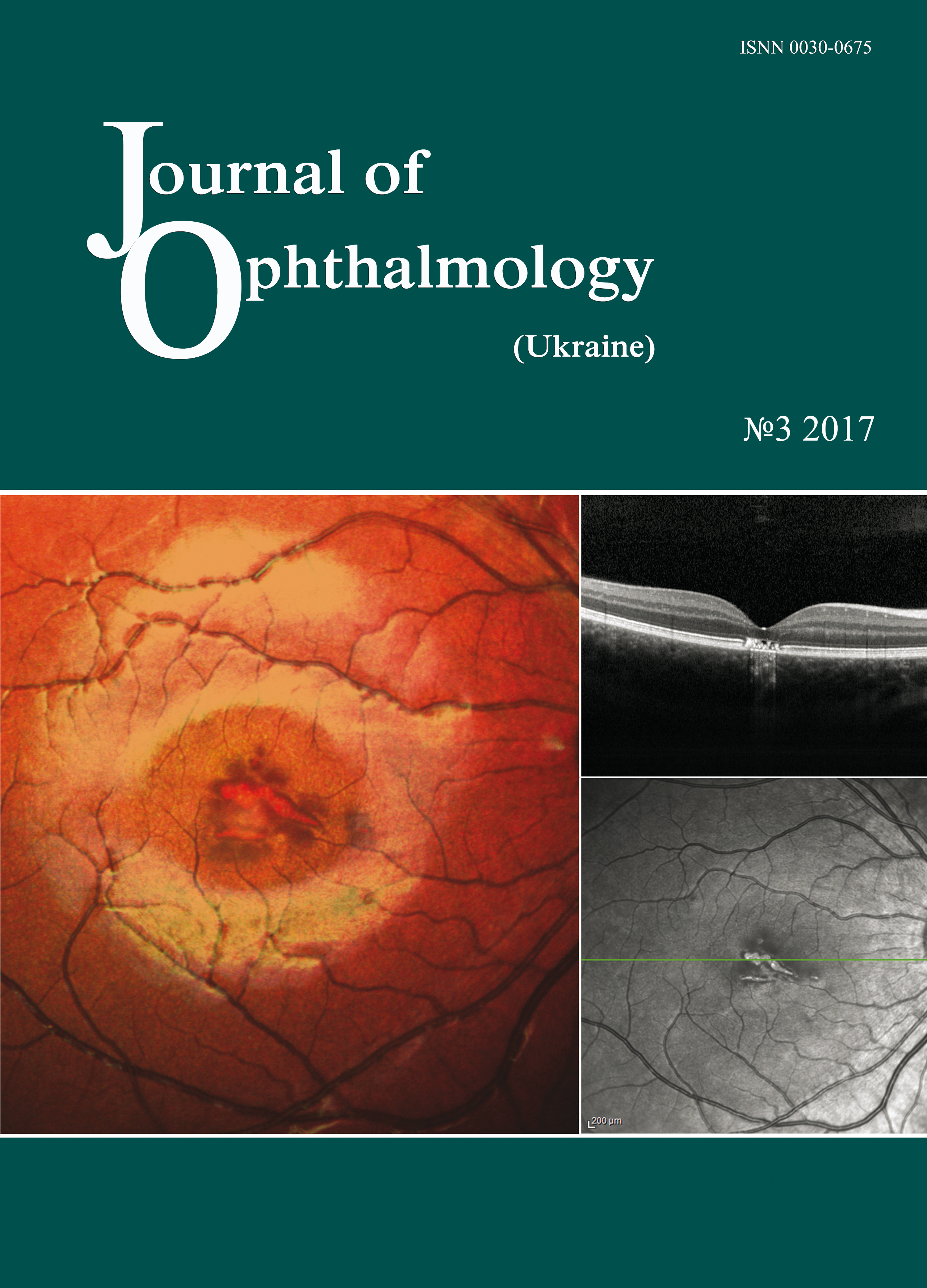
Материал и методы. Представлен клинический анализ лазерных ожогов сетчатки у 5 детей: у 3– свежие ожоги, у 2 — давность 1 год и 5 лет. Трое больных получили ожог лазерной указкой, 1 — лазерным фонариком и девочка 16 лет — на дискотеке. Офтальмоскопически: в макулярной области сглаженность рефлекса, очаги (от 1 до 3) с пигментацией по периферии очагов. У девочки 16 лет в макуле визуализировалось обширное ретинальное кровоизлияние округлой формы. По данным ОКТ, в фовеа под внутренней пограничной мембраной очаги повышенной оптической плотности; перифокальное, нерезко выраженное утолщение внутренних слоев сетчатки и нарушение архитектоники слоев сетчатки. У пациента с исходом ожога — мелкоочаговая атрофия пигментного эпителия по типу retinitis solyaris.
Результаты. Пациентам со свежими ожогами проведена общая и местная дезинтоксикационная, дегидратационная, антиоксидантная терапия. Пациентке с ретинальным кровоизлиянием проведено дренирование методом лазерной задней гиалоидотомии. В результате лечения у всех детей отмечено значительное повышение остроты зрения от 0,4 с миопической коррекцией до 0,5, 0,7.
Выводы. Достичь полного восстановления измененных структур сетчатки в фовеа не представляется возможным, однако своевременное комплексное лечение позволяет получить высокий функциональный результат.
Посилання
Alsulaiman SM, Alrushood AA, Almasaud J, et al. High-power handheld blue laser-induced maculopathy: The results of the King Khaled Eye Specialist Hospital Collaborative Retina Study Group. Ophthalmology. 2014;121:566-72.e1. https://doi.org/10.1016/j.ophtha.2013.09.006
Durukan AH, Kerimoglu H, Erdurman C, et al. Long-term results of Nd: YAG laser treatment for premacular subhyaloid haemorrhage owing to Valsalva retinopathy. Eye (Lond). 2008;22:214-8.https://doi.org/10.1038/sj.eye.6702574
Harris MD, Lincoln AE, Amoroso PJ, et al. Laser eye injuries in military occupations. Aviat Space Environ Med. 2003;74:947-52.
Hossein M, Bonyadi J, Soheilian R, et al. SD-OCT features of laser pointer maculopathy before and after systemic corticosteroid therapy. Ophthalmic Surg Lasers Imaging. 2011;42:e135-8.https://doi.org/10.3928/15428877-20111208-03
Kasaoka M, Ma J, Lashkari K. c-Met modulates RPE migratory response to laser-induced retinal injury. PLoS One. 2012;7:e40771.https://doi.org/10.1371/journal.pone.0040771
Robertson DM, McLaren JW, Salomao DR, Link TP. Retinopathy from a green laser pointer: A clinicopathologic study. Arch Ophthalmol. 2005;123:629-33.https://doi.org/10.1001/archopht.123.5.629
Wyrsch S, Baenninger PB, Schmid MK. Retinal injuries from a handheld laser pointer. N Engl J Med. 2010;363:1089-91.https://doi.org/10.1056/NEJMc1005818
Raoof N, Chan TK, Rogers NK et al. 'Toy' laser macular burns in children. Eye (Lond). 2014 Feb; 28(2): 231-4.https://doi.org/10.1038/eye.2013.315
Allen RD, Brown J, Jr, Zwick H, Schuschereba ST, et al. Laser-induced macular holes demonstrate impaired choroidal perfusion. Retina. 2004;24:92-7.https://doi.org/10.1097/00006982-200402000-00013
ANSI Z136.1-2000. Washington, DC: American National Standards Institute; 2000. American National Standard for the Safe Use of Lasers.
Mainster MA, Stuck BE, Brown J, Jr. Assessment of alleged retinal laser injuries. Arch Ophthalmol. 2004;122:1210-7.https://doi.org/10.1001/archopht.122.8.1210
Keunen JE, Delbecq AL, Cruysberg JR, et al. Laser pointers are not toys; eye injury with permanent loss of visual acuity. Ned Tijdschr Geneeskd. 2014;158:A7813.
Lim ME, Suelzer J, Moorthy RS, Vemuri G. Thermal macular injury from a 154 mW green laser pointer. J AAPOS. 2014 Dec;18(6):612-4.https://doi.org/10.1016/j.jaapos.2014.07.165
Ozawa T1. Laser pointer and laser safety standard. Nippon Ganka Gakkai Zasshi. 2001 Oct;105(10):653-8.
Thanos S, B?hm MR, Meyer zu H?rste M, Schmidt PF. Retinal damage induced by mirror-reflected light from a laser pointer. BMJ Case Rep. 2015.https://doi.org/10.1136/bcr-2015-210311
Weng CY, Baumal CR, Albini TA, Berrocal AM. Self-induced laser maculopathy in an adolescent boy utilizing a mirror. Ophthalmic Surg Lasers Imaging Retina. 2015 Apr;46(4):485-8. https://doi.org/10.3928/23258160-20150422-15
Shenoy R, Bialasiewicz AA, Bandara A. Retinal Damage from Laser Pointer Misuse - Case Series from the Military Sector in Oman. Middle East Afr J Ophthalmol. 2015 Jul-Sep; 22(3): 399-403.https://doi.org/10.4103/0974-9233.159780
Turkana K, Bryan JS, Gordon AJ, et al. Laser pointer induced macular damage: case report and mini review. Int Ophthalmol. 2012;32 (3):293-7.https://doi.org/10.1007/s10792-012-9555-z
##submission.downloads##
Опубліковано
Як цитувати
Номер
Розділ
Ліцензія
Авторське право (c) 2026 Н. Ф. Боброва, Т. А. Сорочинская, Е. А. Суходоева, Е. В. Иваницкая, Н. И. Бахмацкая, И. М. Левицкий

Ця робота ліцензується відповідно до Creative Commons Attribution 4.0 International License.
Ця робота ліцензується відповідно до ліцензії Creative Commons Attribution 4.0 International (CC BY). Ця ліцензія дозволяє повторно використовувати, поширювати, переробляти, адаптувати та будувати на основі матеріалу на будь-якому носії або в будь-якому форматі за умови обов'язкового посилання на авторів робіт і первинну публікацію у цьому журналі. Ліцензія дозволяє комерційне використання.
ПОЛОЖЕННЯ ПРО АВТОРСЬКІ ПРАВА
Автори, які подають матеріали до цього журналу, погоджуються з наступними положеннями:
- Автори отримують право на авторство своєї роботи одразу після її публікації та назавжди зберігають це право за собою без жодних обмежень.
- Дата початку дії авторського права на статтю відповідає даті публікації випуску, до якого вона включена.
ПОЛІТИКА ДЕПОНУВАННЯ
- Редакція журналу заохочує розміщення авторами рукопису статті в мережі Інтернет (наприклад, у сховищах установ або на особистих веб-сайтах), оскільки це сприяє виникненню продуктивної наукової дискусії та позитивно позначається на оперативності і динаміці цитування.
- Автори мають право укладати самостійні додаткові угоди щодо неексклюзивного розповсюдження статті у тому вигляді, в якому вона була опублікована цим журналом за умови збереження посилання на первинну публікацію у цьому журналі.
- Дозволяється самоархівування постпринтів (версій рукописів, схвалених до друку в процесі рецензування) під час їх редакційного опрацювання або опублікованих видавцем PDF-версій.
- Самоархівування препринтів (версій рукописів до рецензування) не дозволяється.