Qualitative assessment of the tear film in young adults
DOI:
https://doi.org/10.31288/oftalmolzh201932025Keywords:
interferometry, lipid layer thickness, tear meniscus, non-invasive break-up timeAbstract
Introduction. Studying the quality of the tear film in young adults, who are the most active users of digital devices, is of extreme interest in clinical practice.
Purpose. To study the qualitative characteristics of the tear film of the eye in young adults.
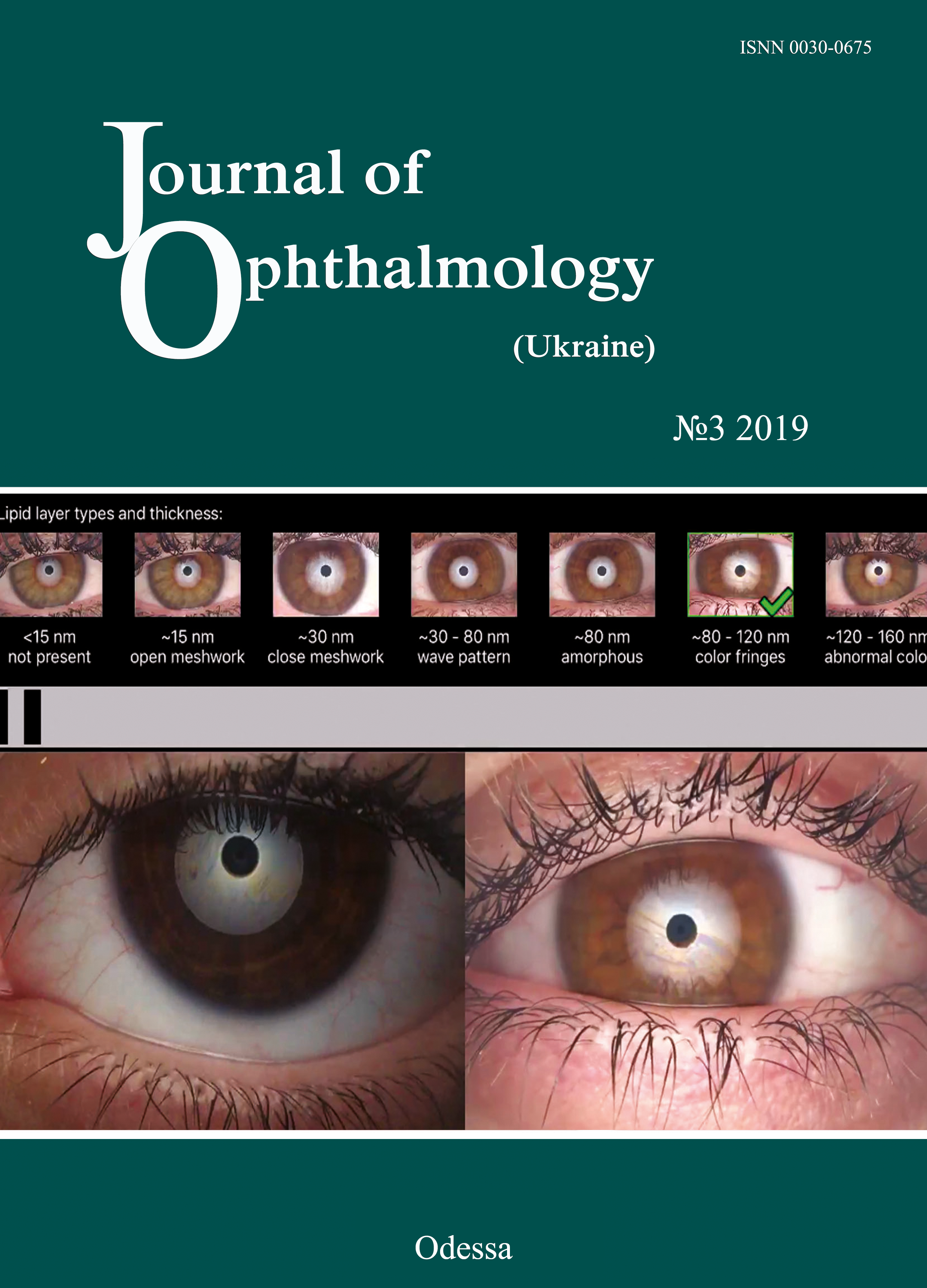
Materials and Methods. We examined 486 eyes of 243 people, aged from 18 to 30, on average (23 ± 0.56). The Ocular Surface Disease Index was determined and the tests were performed in each patient. In addition, interferometry, tear meniscus and Non-invasive break-up time measurements were performed using the SBM ICP Tearscope (Italy) and iPad Pro (the USA) devices.
Results. The examinees, aged 18-30, had the decreased tear film thickness, characterized by a positive correlation between the interferometry data and the tear production tests. The low (category I), moderate (category II), and high (III category) probability of dry eye disease was found in 35% (168 eyes), 31% (152 eyes), and 13% (65 eyes) of the examined young adults, respectively.
Conclusions. Dry eye disease is a common chronic condition affecting the ocular surface in 38-64% of young adults. The thickness of the tear film lipid layer was decreased to 15 and 30-80 nm in 64% of cases; the tear meniscus was decreased in 42% of cases; and the tear film break-up time reduced in 57% of cases. It was possible to estimate the probability of dry eye disease in 79% of cases.
References
1.Bezkorovayna IM, Nakonechnyi DO, Bezkorovayna AO. Characteristics of crystallographic changes in tear in different stages of diabetic retinopathy. J.ophthalmol.(Ukraine).2018;6:35-39. https://doi.org/10.31288/oftalmolzh201863539
2.Brzheskii VV, Egorova GB, Egorov EA. [Laboratory methods for diagnosis of dry eye syndrome]. In: [Dry eye syndrome ocular surface diseases]. 2016: 179-87. In Russian.
3.Zavgorodnya NG, Poplavska IO, Zavgorodnya TS, Litvinenko EE. [Treatment of dry eye syndrome manifistations using an Oxial drug in excimer-laser surgery]. Aktualni pytannya medychnoi nauky ta praktyky. Zaporizhzhya. 2009;75(2): 248-52. In Russian.
4.Maichuk DYu. [Pathogenetic Substantiation of treatment and prophylaxis of secondary tear formation disorders: Author's thesis for Dr. of Med. Sc. M.;2005. 36p. In Russian.
5.Pimenidi MK, Polunin GS, Safonova TN. [Meibomian gland disfunction in computer vision syndrome]. Vestn. Oftalmol. 2010;6:49-52. In Russian.
6.Polunin GS, Polunina EG. [From dry eye to team film disease]. Oftalmologiia. 2012;9(44):78-84. In Russian.
7.Acosta M, Gallar J, Bellmonte C. The influence of eye solutions on blinking and ocular comfort at rest and during work at video display terminals. Expertimental Eye Research. 1999;68(6):663 - 9.https://doi.org/10.1006/exer.1998.0656
8.Craig JP, Nichols KK, Akpek EK et al. TFOS DEWS II Definition and Classification Report. Ocul Surf. 2017;15(3):276 - 83.https://doi.org/10.1016/j.jtos.2017.05.008
9.Farrand KF, Fridman M, Stillman IO, Schaumberg DA. Prevalence of diagnosed dry eye disease in the United States among adults aged 18 years and older. Am J Ophthalmol. 2017;182:90-8.https://doi.org/10.1016/j.ajo.2017.06.033
10.Fuller D.G. Noninvasive tear breakup times and ocular surface disease / D. G. Fuller, K. Potts, J. Kim. // Optom Vis Sci [PUBMED] - 2013 - 90 - P. 1086 - 1091. https://doi.org/10.1097/OPX.0000000000000023
11.Galor A, Feuer W, Lee DJ et al. Prevalence and risk factors of dry eye syndrome in a United States veterans affairs population. Am J Ophthalmol. 2011;152(3): 377-84. https://doi.org/10.1016/j.ajo.2011.02.026
12.Ji Won Jung, Si Yoon Park, Jin Sun Kim at al. Analysis of factors associated with the tear film lipid layer thickness in normal eyes and patients with dry eye syndrome. IOVS 2016;57(10):223 - 7.https://doi.org/10.1167/iovs.16-19251
13.Paulsen AJ, Cruickshanks KJ, Fischer ME et al. Dry eye in the beaver dam offspring study: prevalence, risk factors, and health-related quality of life. / A. J. Paulsen. Am J Ophthalmol. 2014;157(4):799 - 806.https://doi.org/10.1016/j.ajo.2013.12.023
14.Tan LL, Morgan P, Cai ZQ, Straughan RA. Prevalence of and risk factors for symptomatic dry eye disease in Singapore. Clin Experiment Optom. 2015;98(1):45-53.https://doi.org/10.1111/cxo.12210
15.TFOS DEWS II - Diagnostic Methodology. Available at: https://www.tfosdewsreport.org/report-diagnostic_methodology/131_36/en/#.
16.Zhao Y, Tan CL, Tong L. Intra-observer and inter-observer repeatability of ocular surface interferometer in measuring lipid layer thickness. BMC Ophthalmol. 2015; 15:53.https://doi.org/10.1186/s12886-015-0036-9
Downloads
Published
Issue
Section
License
Copyright (c) 2025 І. М. Безкоровайна, Д. О. Наконечний, Дун Фан Хуі, А. О. Безкоровайна

This work is licensed under a Creative Commons Attribution 4.0 International License.
This work is licensed under a Creative Commons Attribution 4.0 International (CC BY 4.0) that allows users to read, download, copy, distribute, print, search, or link to the full texts of the articles, or use them for any other lawful purpose, without asking prior permission from the publisher or the author as long as they cite the source.
COPYRIGHT NOTICE
Authors who publish in this journal agree to the following terms:
- Authors hold copyright immediately after publication of their works and retain publishing rights without any restrictions.
- The copyright commencement date complies the publication date of the issue, where the article is included in.
DEPOSIT POLICY
- Authors are permitted and encouraged to post their work online (e.g., in institutional repositories or on their website) during the editorial process, as it can lead to productive exchanges, as well as earlier and greater citation of published work.
- Authors are able to enter into separate, additional contractual arrangements for the non-exclusive distribution of the journal's published version of the work with an acknowledgement of its initial publication in this journal.
- Post-print (post-refereeing manuscript version) and publisher's PDF-version self-archiving is allowed.
- Archiving the pre-print (pre-refereeing manuscript version) not allowed.